

Last Updated: August 31, 2026
Cut, ground, or polished countertops for a living? Silica dust may be why you can't breathe now.
If you've been diagnosed with silicosis after cutting, grinding, or polishing quartz, granite, or marble countertops in Michigan, you may be entitled to compensation from the companies that made and sold the materials that exposed you...separate from any worker's compensation you're already receiving.
What Silica Dust Does to a Countertop Worker's Lungs
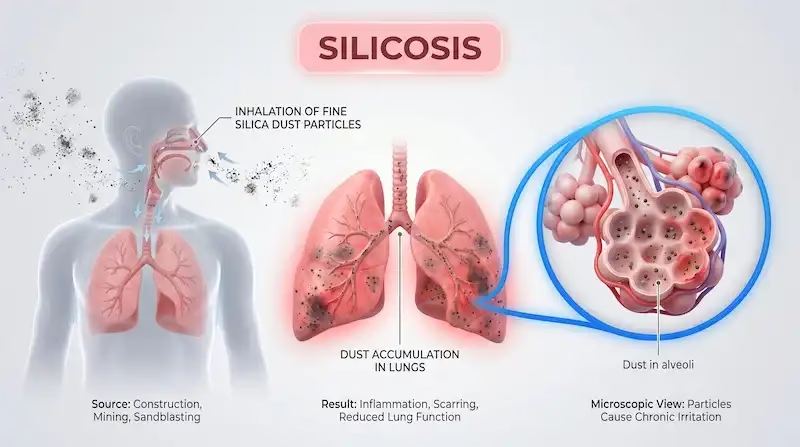
Silicosis is a permanent, incurable scarring of the lungs caused by inhaling crystalline silica dust, the fine particles released when stone slabs are cut, ground, drilled, or polished. Engineered quartz countertops, now standard in kitchen and bath fabrication shops, can contain well over 90% crystalline silica. Natural stone isn't off the hook either, granite and marble slabs also release respirable silica dust during dry-cutting, edge work, and polishing, and fabricators who work across all three materials face exposure from every direction.
The dust is invisible in normal lighting and small enough to lodge deep in the lungs, where the body can't clear it. Over months or years, scar tissue builds up around those particles. That scarring doesn't reverse, and it doesn't stop progressing just because the exposure stops. Manufacturers of engineered stone have known about these silica concentrations for years. Many put the product on the market with warnings that fell far short of the actual danger.
At Serling & Abramson, P.C., we've spent over five decades representing Michigan workers harmed by materials their employers and product manufacturers knew were dangerous. Silicosis follows the same pattern we've litigated for years in asbestos cases: a preventable industrial exposure, a long latency period, and companies that treated warnings as optional.
Symptoms Countertop Fabricators Often Dismiss Too Long
Silicosis rarely announces itself. Fabricators and installers who are used to physically demanding work often push through early symptoms for months before seeing a doctor, and by then, the disease has usually progressed.
- Shortness of breath: Starts during exertion, but can eventually appear even at rest as lung capacity declines.
- Cough that won't clear: Persistent or worsening cough is frequently the first sign something is wrong.
- Chest tightness: Scar tissue restricts the lungs, creating pressure that builds as the disease advances.
- Unusual fatigue: Lungs that can't move oxygen efficiently leave workers drained even without heavy exertion.
If you've cut, ground, or polished quartz, granite, or marble and are noticing any of this, see a pulmonologist for a chest CT and pulmonary function testing before anything else. Your diagnosis is both a medical and a legal starting point, hold onto every record it generates.
Who's Most at Risk in Michigan
Silica exposure hits hardest in the countertop trade, but it isn't limited to one job.
- Countertop fabricators: Dry-cutting and edge-polishing engineered quartz, granite, and marble slabs produces some of the highest silica exposure levels of any occupation.
- Installers: On-site cuts in enclosed kitchens and bathrooms, often with little ventilation, concentrate dust in tight spaces.
- Construction & masonry crews: Cutting brick, block, and concrete on renovation and new-build sites across Michigan carries ongoing exposure risk.
- Foundry & auto supplier workers: Silica sand used in molding and casting operations at Michigan manufacturing plants is a long-documented exposure source.
Separate paths to compensation often apply at once. A worker's compensation claim through your employer, and a civil lawsuit against the manufacturers and suppliers who put the silica-containing product on the market. Filing one does not use up your right to the other, and pursuing a claim against the companies that made the stone doesn't mean suing your employer.
Who May Be Responsible for Your Exposure
Silicosis cases rarely involve just one defendant. We investigate the entire chain that put you in front of that dust, separate from your employer.
- Product manufacturers: Companies that formulated and sold engineered stone slabs with extreme silica content bear the central responsibility in most of these cases. If they knew the risk and failed to warn fabricators adequately, that's a strong basis for a product liability claim.
- Distributors and suppliers: Every business in the supply chain has a duty to pass along accurate safety information. A distributor that moved product downstream without proper warnings doesn't automatically escape liability just because it didn't manufacture the slab.
- Equipment makers: Saws, grinders, and polishers that lacked adequate dust-suppression or water-delivery systems can expose their manufacturers to liability alongside the material producers.
Michigan's Filing Deadline, and Why It's Tighter Than It Looks
Michigan applies a three-year statute of limitations to personal injury and product liability claims like silicosis lawsuits, under MCL 600.5805. Because silicosis can take years to show up after exposure, Michigan also applies the discovery rule: the three-year clock generally starts on the date you were diagnosed, or the date you first knew, or reasonably should have known, that your lung disease was connected to your work, not the date you were originally exposed.
Once you're diagnosed, the clock is running, regardless of how long ago the exposure happened. Waiting even a few months to speak with an attorney can cost you evidence, witnesses, and time you can't get back.
A workers' compensation claim will not, by itself, cover everything silicosis costs a family, it generally doesn't reach pain and suffering, full lost future earning capacity, or the broader impact on your household. A civil claim against the manufacturers and suppliers of the stone you worked with is how Michigan workers pursue that remainder, without any need to bring a claim against your own employer. Your immigration status has no bearing on your right to bring either claim. Michigan law protects the right of every injured worker to seek compensation for harm caused by a negligent company.
What Working With Serling & Abramson, P.C. Looks Like
We built our practice on occupational disease litigation, asbestos, mesothelioma, and related exposure cases, and we bring that same investigative approach to silicosis claims.
- Free, confidential case review: We go through your diagnosis, work history, and the materials you handled, at no cost, with no obligation.
- Full exposure investigation: We trace your work history across every shop and jobsite to identify every manufacturer, distributor, and equipment maker in the chain, no employer lawsuit required.
- Evidence gathering: Medical imaging, employment records, and product documentation form the backbone of a silicosis claim, we assemble it so you don't have to.
- Filing within your deadline: We file the civil suit against manufacturers and suppliers, the workers' compensation claim, or both, whichever your situation calls for, well within Michigan's filing window.
- Negotiation or trial: We pursue full compensation through settlement or, when necessary, at trial, on a contingency basis, so you owe nothing unless we recover for you.
Don't wait on a diagnosis that won't wait on you.
Talk to a Michigan occupational disease attorney about your silicosis diagnosis today. The consultation is free, and there's no obligation to move forward.